Joymore changelog
Communication, Document Journey, Better Reviews & More
Feature
Product Release
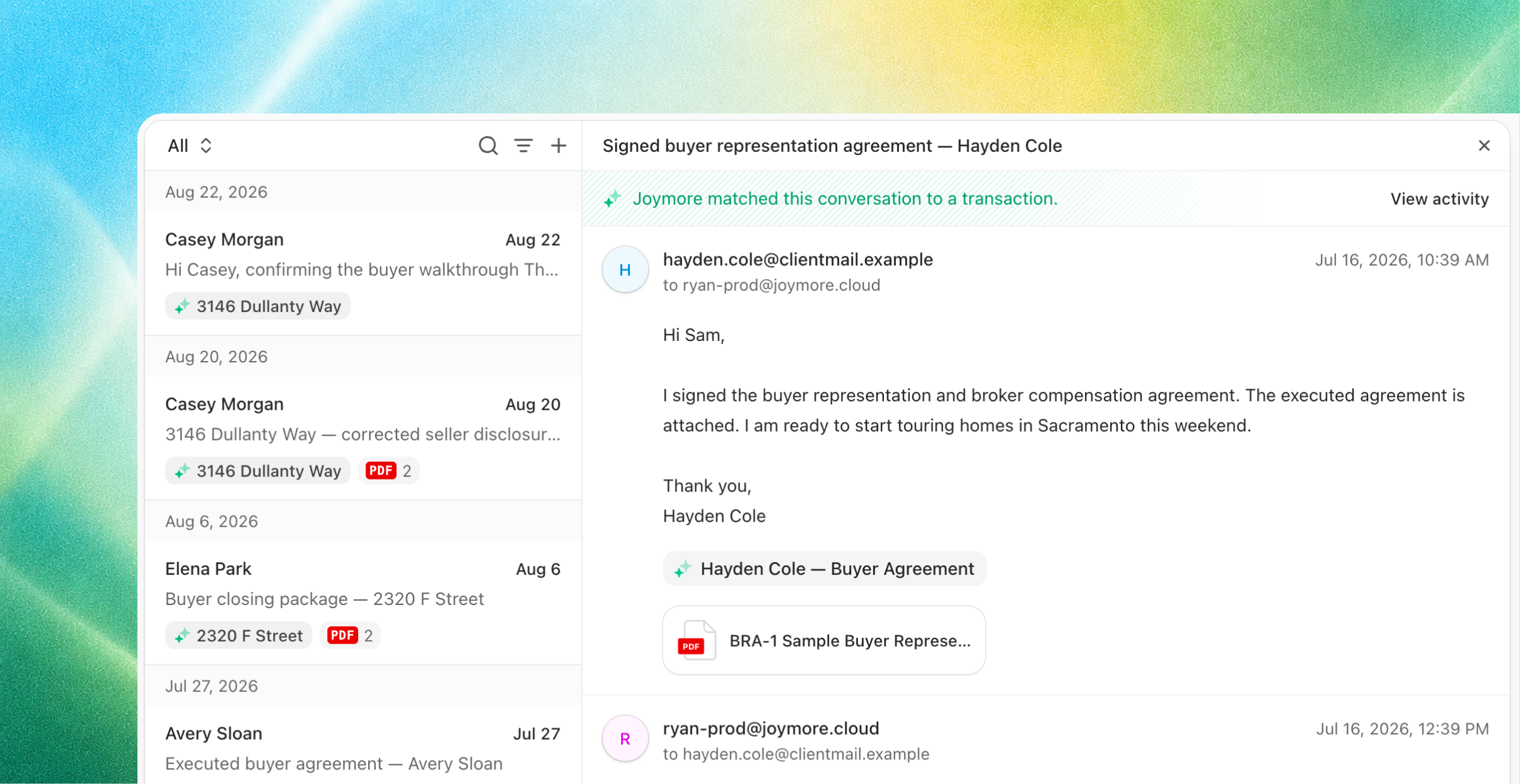
Transaction aware communication
A new Communication view. Every conversation across all of your brokerage's inboxes in one list. Search it, filter by channel or inbox, and open any thread with the full history alongside.
Real folders. Inbox, Sent, Drafts, Scheduled, Archive, and All, in a sidebar with live unread counts. Inbox holds conversations with received mail; Sent holds your outbound messages still awaiting a reply, so neither buries the other.
Every thread shows its file. A conversation displays the transaction it belongs to, and whether it founded that file or was matched to it after the fact.
The same inbox on every file. Each transaction's Communication tab is the very same surface, pinned to that file: only its conversations, the same controls, nothing new to learn.
Emails that sound human. Everything Joymore drafts now follows one voice standard: concise and plain, written like a colleague, never like a system notification.
Refreshed contacts
"Maybe: Jamie · Lone Star Title." Joymore reads new conversations and suggests who the sender might be, from the message itself. One click accepts and creates the contact; dismissing is final. Joymore suggests, you decide.
Contacts got deeper. People now carry roles (a broker who also sells shows as both), per-state licenses, company affiliations, and a preferred way to be reached. Whether someone is actually reachable, by email or text, shows everywhere you pick people, and sends automatically respect opt-outs and each person's preferred channel.

The paper trail, organized
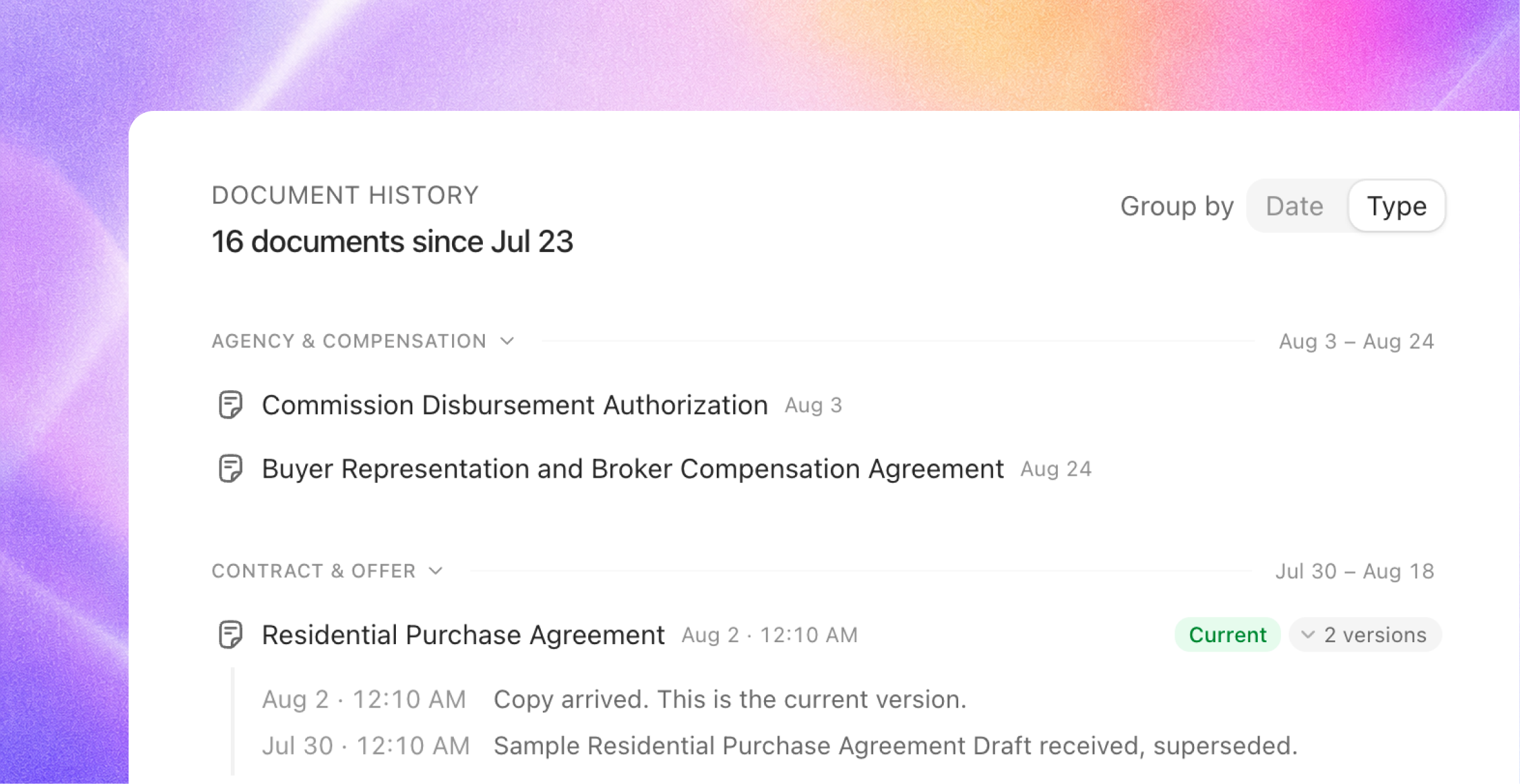
Document history, on the Overview. Every document on the file in one panel, grouped into folders that follow the deal's arc (Agency, Contract, Disclosures, Inspections, Financing, Escrow), newest first, each row dated by the instrument itself. Click any row to open the document in review; expand or collapse the whole history at once.
Versions read like history. Older copies nest under the current one behind an "N versions" chip, each described in plain words with its date ("Replaced Aug 2 · Earlier signatures") and struck through, while the live copy wears a Current badge. Amendments chain to the contract they amend, and a counter shows that it answers the offer.
Real titles, real dates. Documents now carry the instrument name printed on the paper, plus document, executed, effective, and expiration dates, all read from the pages and corrected as better copies arrive. Existing files get their documents re-read and filled in automatically after this release.
Questions instead of guesses. When the paper genuinely conflicts, say two signed versions disagreeing on the price, Joymore raises the question right on the file and waits for your answer instead of picking a side. Your answer is recorded as the controlling decision.
Handwritten changes, caught
Real contracts get marked up: a price crossed out and rewritten, a deadline amended in the margin. Reviews now read those alterations the way a seasoned compliance manager does:
The handwritten value governs. A struck-through term is dead. The live handwritten value drives the file's facts, dates, and checks, and a properly initialed change is treated as the operative term, never flagged as an "inconsistency" with the printed text.
Initials verified at the change. Joymore checks that every altered term carries all parties' initials, and dates where your checklist requires dated acknowledgment, and raises an issue when acknowledgment is missing, grounded in your checklist's own authority and the form's printed terms.
Proof pinned to the pen stroke. Findings on an alteration cite the exact region on the page, with a durable crop of the evidence, so you're looking at the change itself, not hunting for it.
A smoother review
See what's still processing. While Joymore reads new paper, a processing strip appears on every tab of the file, naming the documents not yet incorporated, one click from watching the work live. The overview keeps a single freshness pill (Checking now, Update queued, Up to date) instead of separate per-engine blocks.
Confidence that knows its age. During a re-check, checklist verdicts that could change soften with a "may change" hint, the cover sheet says when its facts were last read, and deciding an issue mid-check asks you to confirm first. Nothing is ever locked; you're just never misled by a confident stale answer.
New files tell their story. A just-created file shows Joymore's initial read from intake (what it found, its best guess) and the pipeline of what happens next, instead of a blank "determining" state.
Live reviews look alive. Opening an in-flight review always shows its live activity feed, so a running review never looks stalled.
Knowledge, maintained automatically
Your knowledge is the instruction layer Joymore manages, not another surface to administer:
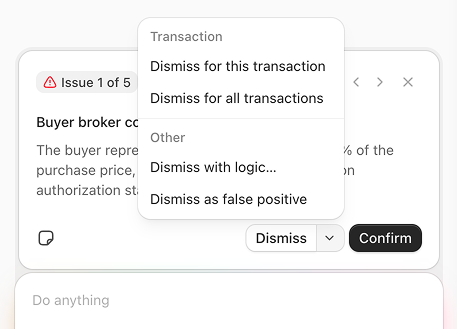
Dismiss once, or dismiss forever. Dismissing an issue now asks its scope: this transaction only, or all transactions, in which case Joymore updates your brokerage's rules in the background, with a progress toast and a link to what changed. Or dismiss with logic ("only dismiss when built after 1975") and Joymore encodes the condition into the rule instead of removing the requirement.
Edits apply directly. When you ask Joymore to change a rule, it makes the change, no separate accept/reject step to click through. Every edit lands in the document's version history, so nothing changes without a record.
Knowledge lives in Settings now. Along with Apps and Automations, it moved out of the main navigation; day-to-day work happens on files and in chat, and the rules are there when you want to inspect them.
Notes are for your team. The issue note field is now called "Internal team note" and reads that way: notes are collaboration, not AI training. Teaching Joymore happens through dismissals and chat.
Chat delivers real files
Ask for a spreadsheet and you get a real spreadsheet:
Excel and CSV with working formulas, PDF reports, zip bundles, plus Markdown, HTML, and plain text.
Files arrive as download cards right in the conversation, and can be attached to outbound email drafts.
Also in this release
Form libraries, visible in Knowledge. The state and publisher form libraries your brokerage uses now appear in the Knowledge library alongside your own documents, so it's always clear which official forms Joymore recognizes. Ask Joymore what's installed and it knows.
Text messaging is rolling out soon. SMS conversations appear alongside email, with message bubbles and a one-line composer. Replies are channel-aware: replying to a text sends a text.
Concessions, itemized. Seller contributions are read with their purpose and payer: closing costs, prepaids, rate buy-downs, discount points. A buyer-broker fee never disappears into one lumped number again.
Report an issue without leaving chat. Tell Joymore something's wrong and, with your approval, it files the report straight to our support team with the context attached.
Tell us how it's going. Rate any response with a thumbs up or down, and Joymore will occasionally ask how a conversation went. Every rating lands directly with our team.
Fixes & improvements
Compliance results no longer go stale: when a re-read corrects the file, the assessment always refreshes with it.
Checklist items no longer present a suggested document as if the required paperwork had arrived; rows show only real matches.
Guidance for sale agreements now lands on the correct checklist item.
Asking for a review when nothing has changed returns the latest results instead of re-running the whole review.
When a date changes, every deadline calculated from it is marked as recalculating instead of quietly showing the old value, and a recalculating date never fires reminders.
Financing terms written as prose on the contract now read into the file correctly.
Joymore knows which page and document you have open when you chat, so "summarize this" just works.
Background work, like document intake, can now raise a question to your team when it hits a real decision, and those questions stay in the app.
A document that fails to download from a provider no longer stalls intake; Joymore notes the failure and keeps working.
You're no longer notified about transient background hiccups Joymore recovers from on its own.
When a message can't be sent, the refusal names exactly which recipient is unreachable, instead of a generic error.
Chat messages send and display exactly as you typed them; pasted text no longer sprouts stray backslashes or escape artifacts.
Seller representation is now labeled "List side" instead of "Sell side", matching standard industry wording.
Extracted contact fields can now be edited, not just added.
Chat history now lives on the Chats page.
Chat's corner controls are always visible, no hover required.
Attachments in chat render as clean file cards; images keep their thumbnails.
Transaction pages no longer flash or reload the document when a review starts streaming, and live updates render noticeably smoother.
The Communication page no longer opens a chat on arrival; chat opens when you ask for it.
Browser tab titles now lead with the page name, so Joymore tabs are findable in a crowded browser.
The actions menu on your own row in the People grid no longer opens empty.
Old bookmarked inbox links land gracefully instead of erroring.
Fixed rare "Forbidden" errors that could lock a single user out, typically right after a deploy.
Activity records for long-running work no longer cut off partway through, and no longer sit hours behind the work itself.
A file with no matching checklist is no longer a dead end: it explains which checklists were considered and why each didn't apply, you can link the right one yourself in a click, and the file's documents stay visible either way.
A brokerage's only checklist now applies to its files instead of being skipped on a technicality, and checklists created with Joymore in chat produce real checklist items.
Closed transactions appear on the transactions list again when filtering by status.